
ODM or OEM Jewelry Manufacturing for a First Run
OEM and ODM are two different starting points, not two price tiers. In the manufacturer's own wording, OEM is "you design, we produce" and ODM is "you inspire, we create". MOQ is 100 plus in stainless steel, 100 pieces in artisan eco-brass and 50 pcs in the silver line, by design.
Key takeaways
- OEM fits a brand that arrives with drawings or a tech pack; ODM fits a brand that arrives with a concept and no file.
- Both routes run the same schedule: sampling at CAD CAD the master sample takes 25–30 days, mass production a further 3–4 weeks, CAD under 48 hours — CAD, sample, run of production for production.
- Minimums are per design, not per order: 50 pcs in eco-brass, stainless work and 925 sterling silver.
- Designs are covered by 100% NDA and moulds, CAD files and collections are not resold to other buyers.
The two routes in the manufacturer's own words
OEM is described as "you design, we produce": the brand brings the CAD file or tech pack, the factory builds it, and the intellectual property stays 100% with the brand. ODM is described as "you inspire, we create": the factory's design team develops the concept into a co-created collection that belongs to that brand alone.
The practical difference for a first run is who supplies the drawing. If your team can specify wall thickness, stone seat and chain attachment, OEM removes a whole round of interpretation. If the idea is still a mood board, ODM is the shorter path, because the first CAD iteration is produced for you rather than by you.
What a first run needs that the fifth run does not
A first run has one job: prove the design in metal and in front of a customer. That argues for the smallest commitment the factory accepts rather than the largest, which is why the published minimum ladder matters more on order one than on order five. Silver starts at 50 pieces per design, eco-brass at 100 and stainless steel at 100+.
It also argues for keeping the variations narrow. Every added colourway, stone or chain option multiplies the number of parts that have to be sourced, plated and inspected before anything can ship, and the 3–4 week production window is quoted for one design, not for a family of them.
The plating question decides where a first run sits
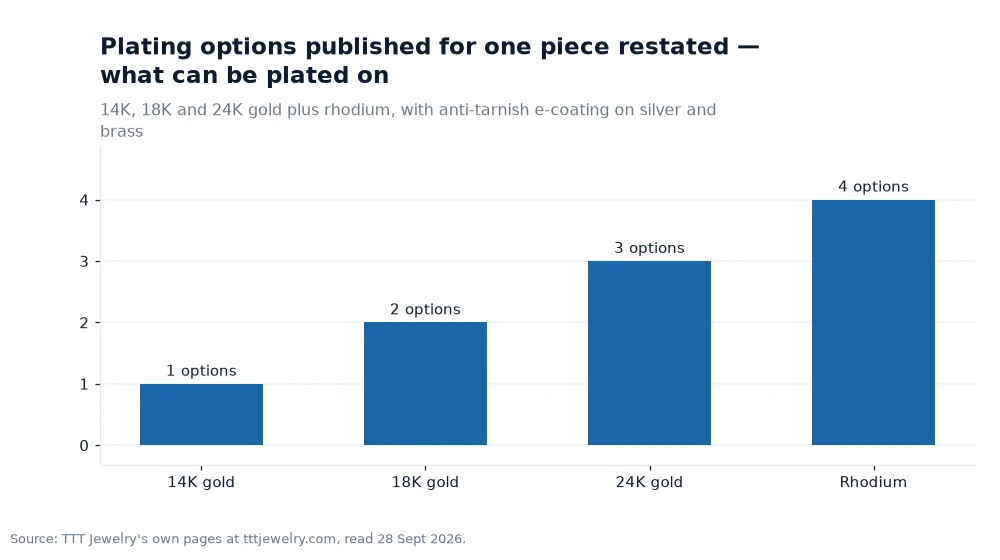
rhodium, an anti-tarnish e-coat applied to silver and brass, vacuum PVD plating for steel and multi-layer gold in 14K, 18K and 24K.
Two of those choices change the manufacturing route rather than just the look. An anti-tarnish e-coating is an extra pass after plating, and PVD is a different process entirely, which is why the stainless steel minimum sits at 100+ pieces rather than 50. Pick the finish knowing which of those you are buying into.
Compliance paperwork a first retail partner will ask for
Before a new stockist takes a first delivery, someone in their office wants three things on paper: a quality system, a labour standard and a materials statement. On the OEM/ODM route those are A BSCI audit, ISO 9001:2015 and REACH compliance on lead, cadmium and nickel, which for jewelry means lead, cadmium and nickel.
The same pages carry the hallmark set — S925 on silver, 316L on stainless and an 18KGP mark on plated work for gold-plated — and these engravings are part of the compliance story, since a claim about what a piece is made of has to be readable on the piece.
Where a first run usually slips
It rarely slips in the workshop. It slips at the approval gates that belong to the buyer: the dimensional sign-off on the CAD, the sample approval at the end of the 25–30 day window, and the packaging decision, which is often left until the last week and covers five separate components. Gift boxes, pouches, backing cards, logo tags and barcode labels each need artwork before anything can be packed.
The countermeasure is boring. Approve in writing, ask for the inspection record at the end, and confirm that the piece is 100% inspected before packing. A dedicated project manager and a 24-hour response window are what make that sequence survivable at first-order pace.
Three questions that choose the route for you
First: does a usable file exist? A yes points to OEM. Second: who owns the concept if the factory develops it? Under ODM the answer is still the brand, and the terms are worth seeing on paper, which is where a brand that wants the design-protection terms explained before tooling will learn more about how exclusivity is handled.
Third: how many pieces can sit in stock for six months? That number decides the material, and the material decides the minimum. The full route, including the six customisation options on a single order, is set out at www.tttjewelry.com/oem-odm-jewelry-manufacturer/.
| Question | OEM route | ODM route |
|---|---|---|
| What the brand brings | CAD file, tech pack or reference photos | A concept, mood board or sample piece |
| Who creates the design | The brand, produced by the factory | The factory team, developed with the brand |
| Where the IP sits | 100% with the brand | Exclusive to that brand, moulds not resold |
| Schedule | 48 hours CAD, 25–30 days sample, 3–4 weeks production | Same gates and same windows |
Worked example: fitting a minimum onto a size curve
Take a single design in artisan eco-brass, minimum 100 pieces per design, and a size run of five sizes. Spread evenly, that is 100 ÷ 5 = 20 pieces per size. The same design in 925 sterling silver has a minimum of 50 pieces per design, which works out at 50 ÷ 5 = 10 pieces per size.
The minimum applies per design, so this arithmetic describes how the pieces land on the size curve, not a discount for buying in bulk. What it does show is the shape of a first-run commitment: a silver version of the same idea carries half the units of the brass version, and stainless steel at 100+ sits above both.
If 10 or 20 pieces per size is more than you can sell in a reasonable period, the right answer is fewer sizes or a simpler design, not a smaller order.
Frequently asked questions
What is the difference between OEM and ODM jewelry manufacturing?
OEM means the brand supplies the design and the factory produces it; ODM means the factory's design team develops the collection with the brand. Both run the same sampling and production windows.
How small can a first production run be?
The entry quantities are 100 in the eco-brass line, 50 in the silver line and 100 plus in stainless work, counted per design, with each design counted separately.
How long does a first order take to reach shipment?
Plan on under 48 hours for 3D CAD, 25–30 days for the master sample and 3–4 weeks of mass production, plus your own approval time at each gate.
Picking the route without over-committing
Match the route to what you actually hold: a file, or an idea. Then match the material to the size of the bet you are willing to carry, and let the plating decision follow the wear pattern the piece is meant for. Brands weighing a plated base metal first are usually better served by the eco-brass line, while a piece meant to carry a retail price on its material alone belongs with the 925 sterling silver route.
Where the numbers come from — the eight-stage factory route with the five packaging components, followed by the master sample rule — is the manufacturer's own pages over at tttjewelry.com, which I checked on 28 Sept 2026. The order-of-magnitude reading is mine, while the source figures stay the client's[1].