
PPS+ or PPLNS: A First-Timer's Choice at 375 TH/s
The first decision most new miners face is not which machine to buy but how they want to be paid. A pool can settle a fixed credit against difficulty every hour, or it can share blocks after they confirm. At 375 TH/s the difference is not the size of the daily number, about 0.00016823 BTC or $14.25 gross, but when and how reliably that number arrives.

Key takeaways
- PPS+ is the default: 4% listed on the block-reward component, 2% on the transaction-fee component, credited hourly.
- PPLNS charges a listed 2% on both components but pays only after a block reaches six confirmations.
- 375 TH/s produces 0.00016823 BTC a day, or $13.68 net under the hourly scheme.
- Choose by cash flow first; a home miner with a monthly power bill rarely benefits from waiting.
The two promises a pool can make
Under PPS+, the block-reward part of your income is paid per share at a fixed rate tied to current difficulty. The pool carries the luck. If it finds fewer blocks than expected this week, your credit does not change, because you were paid for the shares you submitted rather than for the blocks the pool happened to find. That certainty is what the higher listed rate on that component buys.
Under PPLNS, nothing is fixed in advance. The pool waits for a block, confirms it six times, then splits the reward across miners according to their share of the pool's hashrate over the last five difficulty rounds. A lucky stretch pays more than the PPS+ equivalent; a dry stretch pays less. The listed rate is 2% on the combined reward, and the miner absorbs the variance in exchange.
Neither scheme is a trick, and neither is universally better. They are two different distributions of the same underlying block rewards, one smoothed and one lumpy, priced differently because the pool's exposure differs.
Where the listed fee actually lands
The common mistake is to read 4% and 2% as a single total and assume PPS+ costs twice as much. It does not, because the percentages attach to different streams. In PPS+, the 4% applies to the block-reward component, while the transaction-fee component is distributed on PPLNS logic at a listed 2%. In PPLNS, the 2% applies to both components combined.
The practical effect is that the gap between the two schemes is smaller than the headline numbers suggest, and it moves with fee revenue on the network. A busy mempool makes the fee component a larger slice, which narrows the distance further. A quiet one leaves the block subsidy dominant, and the 4% versus 2% gap widens.
Read the fee schedule as three separate statements rather than one, and the arithmetic stops being mysterious. Every figure in this article is the listed rate, not an estimate of a blended cost.
Cash flow is the tiebreaker for small miners
A home miner paying a power bill every month has a predictable cost and, under PPLNS, an unpredictable income. That mismatch is the real argument for the hourly scheme. At 375 TH/s the net credit is $13.68 a day, which covers a modest power draw without needing a good block to land at the right moment.
A larger operation with reserves can afford to wait and may prefer the lower listed rate. The variance that hurts a single machine is absorbed easily across a rack, and the long-run average is the number that matters when the power contract runs for a year. That is a balance-sheet decision, not a technical one.
There is a middle path that many miners use without naming it: start on PPS+, learn the rhythm of the credits, then test PPLNS for a fixed period with a written start and end date. Comparing the two from memory is unreliable; comparing two statements is not.
| Question | PPS+ | PPLNS |
|---|---|---|
| Listed rate on the block reward | 4% | 2%, applied to both components |
| Listed rate on transaction fees | 2% | 2%, applied to both components |
| When coins arrive | Hourly, against current difficulty | After six confirmations |
| Who carries pool luck | The pool | The miner |
Worked example
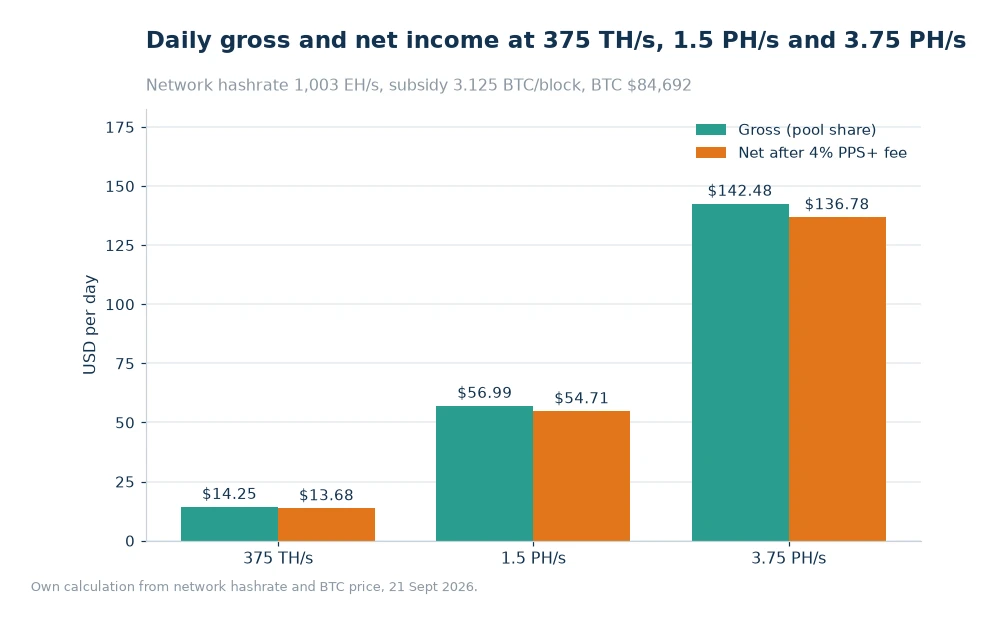
Take the smallest step in the chart and follow it through both the gross and net figures, then scale up to the two larger sizes.
- One terahash of the 1,003 EH/s network earns 450 ÷ 1,003,000,000 = 0.00000044865 BTC in a day.
- 375 TH/s: 375 × 0.00000044865 = 0.00016823 BTC a day.
- At $84,692: 0.00016823 × 84,692 = $14.25 gross.
- The listed 4% applies to the block-reward part, leaving 14.25 × 0.96 = $13.68.
- 1.5 PH/s is four times the hashrate: 0.00067298 BTC, $56.99 gross and $54.71 net.
- 3.75 PH/s is ten times: 0.00168245 BTC, $142.48 gross and $136.78 net.
- Monthly net at the first size: 30 × $13.68 = $410.40, which is the figure a power bill has to fit inside.
A test period with a written end date
If you want to try PPLNS, define the experiment before you switch. Two weeks is a reasonable minimum: it spans more than a difficulty window and gives the pool enough blocks for the share calculation to be meaningful. Write down the start date, the end date, the hashrate and the settlement mode, then leave all four alone until the end.
During the test, record the BTC credited each day rather than the dollar value. Price moves will otherwise dominate a comparison that is supposed to be about settlement. At the end, divide the total by the number of days and hold it against the PPS+ rate at the same hashrate.
One warning about short tests: a single lucky block inside two weeks can flatter PPLNS badly, and a single dry spell can make it look broken. Judge the shape of the series, not just the total, and be prepared for the answer to be "roughly the same" — which is often the truthful result.
Switching later without losing a day
The mode can be changed, but the balance does not teleport. Under PPLNS, shares already submitted belong to a window that has not closed; switching mid-window means waiting for the next block and its six confirmations before that final payment lands. Plan the change for a moment when the old balance has cleared, and the transition costs nothing.
Keep both statements for the month of the change. The old one is the only record of the closing PPLNS window, and the new one starts the hourly series. Filed together, they read as one continuous account.
ViaBTC Bitcoin Mining keeps the payout mode, the worker list and the balance on the same account page, so a switch is a settings change rather than a new relationship. That matters most to a first-timer, who should be able to try both schemes without rebuilding anything.
Frequently asked questions
Is PPS+ always the safer choice?
It is the steadier choice, because the block-reward component is settled hourly and the pool carries the luck, but it carries a listed 4% on that component against 2% under PPLNS.
How long until a PPLNS payment arrives?
A block must be found and reach six confirmations, then the pool distributes the miner's share of the last five difficulty rounds, so the wait depends on pool luck rather than on a fixed clock.
Does switching schemes change my hashrate?
No. The machines keep submitting the same shares; only the way those shares are converted into a balance changes, so a 375 TH/s rig still earns 0.00016823 BTC a day before fees.
Write the decision down and stop revisiting it
Most miners lose more to indecision than to either fee. Pick a scheme that matches the bills you have to pay, set a review date three months out, and spend the intervening time watching the machine rather than the menu. The Profit Calculator will tell you what a given hashrate should produce at current difficulty, which is the number to check your statement against.
When the review date arrives, compare two full statements, not two impressions. If the hourly scheme covered the power bill and left something over, the decision was fine regardless of what a lucky PPLNS month might have paid.
Sources: ViaBTC fee schedule and calculator pages, for listed rates and settlement terms[1]. Market and chain inputs on 21 Sept 2026: BTC $84,692; network 1,003 EH/s; difficulty 132.76 T; 3.125 BTC every block across 144 daily blocks. Published 24 Oct 2026.